
Biclustering with Infinite Relational Model
Source:R/07_IRM.R, R/17_Biclustering_nominal_IRM.R, R/18_Biclustering_ordinal_IRM.R, and 1 more
Biclustering_IRM.RdThis function performs Biclustering structure learning using the Infinite Relational Model (IRM) to automatically determine the optimal number of classes C and optimal number of fields F. It dispatches to the appropriate method based on the data type: binary, ordinal, or nominal. For binary data, see Section 7.8 in Shojima(2022). For nominal data, a Dirichlet-Multinomial collapsed Gibbs sampler is used.
Usage
Biclustering_IRM(U, ...)

# Default S3 method
Biclustering_IRM(U, na = NULL, Z = NULL, w = NULL, ...)

# S3 method for class 'binary'
Biclustering_IRM(
  U,
  na = NULL,
  Z = NULL,
  w = NULL,
  gamma_c = 1,
  gamma_f = 1,
  maxiter = 100,
  stable_limit = 5,
  minSize = 20,
  EM_limit = 20,
  seed = 123,
  verbose = FALSE,
  ...
)

# S3 method for class 'nominal'
Biclustering_IRM(
  U,
  gamma_c = 1,
  gamma_f = 1,
  alpha = 1,
  maxiter = 100,
  stable_limit = 5,
  minSize = 20,
  EM_limit = 20,
  seed = 123,
  verbose = FALSE,
  ...
)

# S3 method for class 'ordinal'
Biclustering_IRM(
  U,
  gamma_c = 1,
  gamma_f = 1,
  alpha = 1,
  mic = FALSE,
  maxiter = 100,
  stable_limit = 5,
  minSize = 20,
  EM_limit = 20,
  seed = 123,
  verbose = FALSE,
  ...
)

# S3 method for class 'rated'
Biclustering_IRM(
  U,
  gamma_c = 1,
  gamma_f = 1,
  alpha = 1,
  maxiter = 100,
  stable_limit = 5,
  minSize = 20,
  EM_limit = 20,
  seed = 123,
  verbose = FALSE,
  ...
)
Arguments
- U
U is either a data class of exametrika, or raw data. When raw data is given, it is converted to the exametrika class with the dataFormat function.
- ...
Additional arguments passed to specific methods.
- na
na argument specifies the numbers or characters to be treated as missing values.
- Z
Z is a missing indicator matrix of the type matrix or data.frame
- w
w is item weight vector
- gamma_c
\(\gamma_C\) is the hyperparameter of the CRP and represents the attractiveness of a new Class. As \(\gamma_C\) increases, the student is more likely to be seated at a vacant class. The default is 1.
- gamma_f
\(\gamma_F\) is the hyperparameter of the CRP and represents the attractiveness of a new Field. The greater this value it more likely to be classified in the new field. The default is 1.
- maxiter
A maximum iteration number of IRM process. The default is 100. (Renamed from
max_iterin v1.15.0; the old name is still accepted with a deprecation warning.)- stable_limit
The IRM process exits the loop when the FRM stabilizes and no longer changes significantly. This option sets the maximum number of stable iterations, with a default of 5.
- minSize
A value used for readjusting the number of classes.If the size of each class is less than
minSize, the number of classes will be reduced. Note that this under limit of size is not used for either all correct or all incorrect class.- EM_limit
After IRM process, resizing the number of classes process will starts. This process using EM algorithm,
EM_limitis the maximum number of iteration with default of 20.- seed
Random seed for reproducibility. When a numeric value is provided,
set.seed(seed)is called before the Gibbs sampling begins, ensuring reproducible results. The default is123, which guarantees deterministic output. Set toNULLto disable seed setting and let the results depend on the current state of the random number generator.- verbose
verbose output Flag. default is FALSE
- alpha
Dirichlet distribution concentration parameter for the prior density of field reference probabilities (rated/nominal IRM). Must be positive. The default is 1.
- mic
Logical; if TRUE, relabels the classes in ascending order of their total expected score, summed over all fields (ordinal IRM only). Default is FALSE. Note that this is a cosmetic reordering of class labels: it makes the Test Reference Profile monotone (WOAC) but does not impose the per-field stochastic order (SOAC), and it leaves the estimates themselves unchanged. IRM classes come from a CRP prior and are exchangeable, so there is no rank axis for an order restriction to act on; use ordinal Ranklustering (
Biclustering(method = "R", estimation = "isotonic")) when a genuine order restriction is wanted.
Value
An object of class "exametrika" containing the IRM results.
See Biclustering_IRM.binary or Biclustering_IRM.nominal for details.
- nobs
Sample size. The number of rows in the dataset.
- msg
A character string indicating the model type.
- testlength
Length of the test. The number of items included in the test.
- n_class
Optimal number of classes (new naming convention).
- n_field
Optimal number of fields (new naming convention).
- em_cycle
Number of EM algorithm iterations (new naming convention).
- n_class
Optimal number of classes.
- n_field
Optimal number of fields.
- EM_Cycle
Number of EM algorithm iterations (deprecated, use em_cycle).
- BRM
Bicluster Reference Matrix
- FRP
Field Reference Profile
- FRPIndex
Index of FFP includes the item location parameters B and Beta, the slope parameters A and Alpha, and the monotonicity indices C and Gamma.
- TRP
Test Reference Profile
- FMP
Field Membership Profile
- Students
Rank Membership Profile matrix.The s-th row vector of \(\hat{M}_R\), \(\hat{m}_R\), is the rank membership profile of Student s, namely the posterior probability distribution representing the student's belonging to the respective latent classes. It also includes the rank with the maximum estimated membership probability, as well as the rank-up odds and rank-down odds.
- LRD
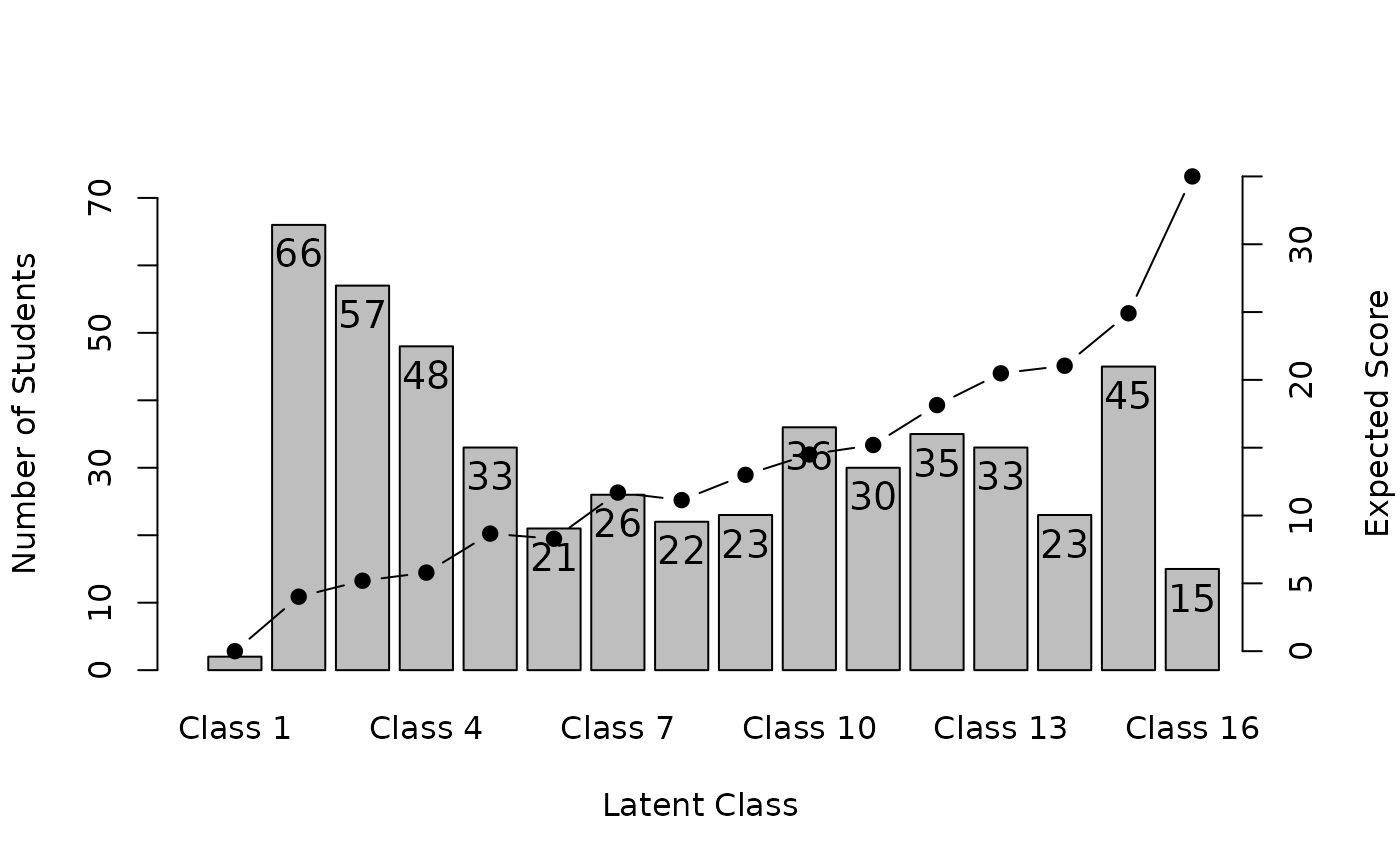
Latent Rank Distribution. see also plot.exametrika
- LFD
Latent Field Distribution. see also plot.exametrika
- RMD
Rank Membership Distribution.
- TestFitIndices
Overall fit index for the test.See also TestFit
- elbo, log_lik_marginal, entropy, ICL
Variational fit quantities on the final assignment, as for
Biclustering. Since 2.2.0.
For nominal data, the returned list includes:
- Q
Response matrix.
- Z
Missing indicator matrix.
- testlength
Number of items.
- nobs
Sample size.
- n_class
Optimal number of classes.
- n_field
Optimal number of fields.
- n_cycle
Number of EM algorithm iterations.
- FRP
Field Reference Profile, a 3D array (nfld x ncls x maxQ).
- LFD
Latent Field Distribution.
- LCD
Latent Class Distribution.
- FieldMembership
Field membership probability matrix.
- ClassMembership
Class membership probability matrix.
- FieldEstimated
Estimated field assignment for each item.
- ClassEstimated
Estimated class assignment for each student.
- Students
Rank Membership Profile matrix with estimated class.
- TestFitIndices
Overall fit index for the test.
- log_lik
Evidence lower bound of the model (equal to
elbo).- elbo
Evidence lower bound of the observed-data log-likelihood under the posterior memberships the EM produced. Exact (equal to the observed-data log-likelihood) for a one-mode model; a lower bound for biclustering, where the respondent and item posteriors are taken independent. Since 2.2.0.
- log_lik_marginal
Observed-data log-likelihood of the respondent-side mixture with the items fixed at their MAP field assignment. Equal to
elbofor a one-mode model.- entropy
Posterior entropy of the memberships (named:
class, andfieldfor biclustering).elbominus this is the expected complete-data log-likelihood.- ICL
Integrated completed likelihood criterion (Biernacki, Celeux and Govaert, 2000) in its BIC-type approximation, on the same scale as AIC and BIC (-2 log scale, smaller is better).
For ordinal data, the returned list includes:
- Q
Response matrix.
- Z
Missing indicator matrix.
- testlength
Number of items.
- nobs
Sample size.
- n_class
Optimal number of classes.
- n_field
Optimal number of fields.
- n_cycle
Number of EM algorithm iterations.
- FRP
Field Reference Profile (BCRM), a 3D array (nfld x ncls x maxQ).
- FRPIndex
Index of FRP includes the item location parameters B and Beta, the slope parameters A and Alpha, and the monotonicity indices C and Gamma.
- TRP
Test Reference Profile, computed from the model (since 2.2.0).
- TRP_empirical
The same profile from the data (mean observed scores of the class members). Since 2.2.0.
- BFRP
Bicluster Field Reference Profile (expected scores), a list with Weighted and Observed components.
- LFD
Latent Field Distribution.
- LCD
Latent Class Distribution.
- FieldMembership
Field membership probability matrix.
- ClassMembership
Class membership probability matrix.
- FieldEstimated
Estimated field assignment for each item.
- ClassEstimated
Estimated class assignment for each student.
- Students
Rank Membership Profile matrix with estimated class.
- TestFitIndices
Overall fit index for the test.
- log_lik
Evidence lower bound of the model (equal to
elbo).- elbo
Evidence lower bound of the observed-data log-likelihood under the posterior memberships the EM produced. Exact (equal to the observed-data log-likelihood) for a one-mode model; a lower bound for biclustering, where the respondent and item posteriors are taken independent. Since 2.2.0.
- log_lik_marginal
Observed-data log-likelihood of the respondent-side mixture with the items fixed at their MAP field assignment. Equal to
elbofor a one-mode model.- entropy
Posterior entropy of the memberships (named:
class, andfieldfor biclustering).elbominus this is the expected complete-data log-likelihood.- ICL
Integrated completed likelihood criterion (Biernacki, Celeux and Govaert, 2000) in its BIC-type approximation, on the same scale as AIC and BIC (-2 log scale, smaller is better).
- SOACflg
Logical; TRUE if Strongly Ordinal Alignment Condition is satisfied.
- WOACflg
Logical; TRUE if Weakly Ordinal Alignment Condition is satisfied.
For rated data, the returned list includes:
- Q
Response matrix.
- U
Binary correct/incorrect matrix.
- Z
Missing indicator matrix.
- testlength
Number of items.
- nobs
Sample size.
- n_class
Optimal number of classes.
- n_field
Optimal number of fields.
- n_cycle
Number of EM algorithm iterations.
- FRP
Field Reference Profile (BCRM), a 3D array (nfld x ncls x maxQ).
- FieldFRP
Field Reference Profile based on binary correct rates (nfld x ncls).
- quasiFRP
Item-level correct response rate per class (nitems x ncls).
- FRPIndex
Index of FRP includes the item location parameters B and Beta, the slope parameters A and Alpha, and the monotonicity indices C and Gamma.
- TRP
Test Reference Profile.
- LFD
Latent Field Distribution.
- LCD
Latent Class Distribution.
- FieldMembership
Field membership probability matrix.
- ClassMembership
Class membership probability matrix.
- FieldEstimated
Estimated field assignment for each item.
- ClassEstimated
Estimated class assignment for each student.
- Students
Rank Membership Profile matrix with estimated class.
- FieldAnalysis
Field analysis with CRR and field memberships.
- TestFitIndices
Overall fit index for the test (binary layer, default).
- TestFitIndices_nominal
Fit indices for the nominal layer (AIC/BIC/CAIC only).
- log_lik
Log-likelihood of the binary layer model.
- log_lik_nominal
Evidence lower bound of the nominal layer model.
- elbo_nominal
Evidence lower bound of the observed-data log-likelihood under the posterior memberships the EM produced. Exact (equal to the observed-data log-likelihood) for a one-mode model; a lower bound for biclustering, where the respondent and item posteriors are taken independent. Since 2.2.0. Computed on the nominal layer.
- log_lik_marginal_nominal
Observed-data log-likelihood of the respondent-side mixture with the items fixed at their MAP field assignment. Equal to
elbofor a one-mode model.- entropy_nominal
Posterior entropy of the memberships (named:
class, andfieldfor biclustering).elbominus this is the expected complete-data log-likelihood.- ICL_nominal
Integrated completed likelihood criterion (Biernacki, Celeux and Govaert, 2000) in its BIC-type approximation, on the same scale as AIC and BIC (-2 log scale, smaller is better).
- SOACflg
Logical; TRUE if Strongly Ordinal Alignment Condition is satisfied.
- WOACflg
Logical; TRUE if Weakly Ordinal Alignment Condition is satisfied.
Examples
# \donttest{
# Fit a Biclustering model with automatic structure learning using IRM
# gamma_c and gamma_f are concentration parameters for the Chinese Restaurant Process
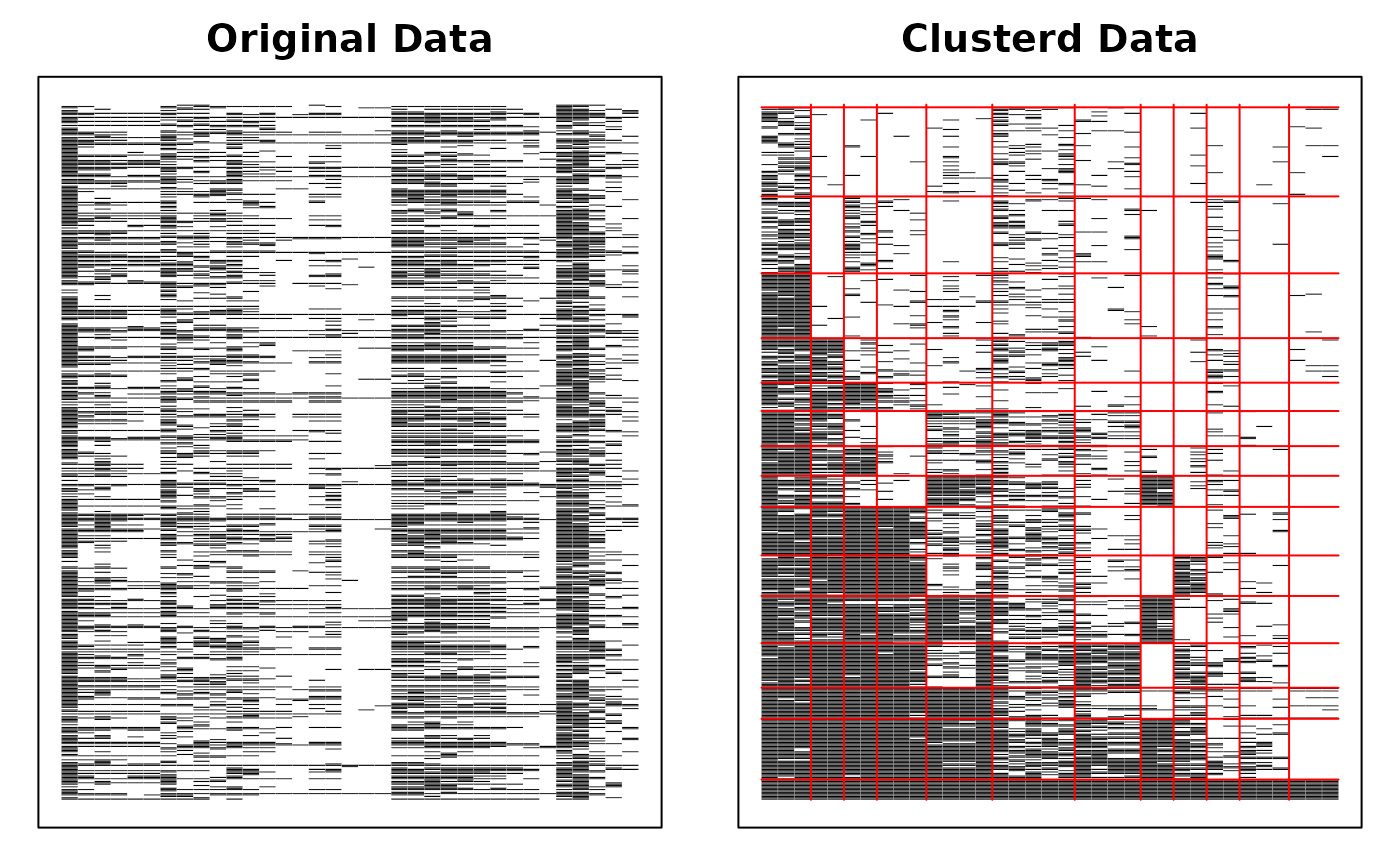
result <- Biclustering_IRM(J15S500, gamma_c = 1, gamma_f = 1)
# Display the Bicluster Reference Matrix (BRM) as a heatmap
plot(result, type = "Array")
 # Plot Field Reference Profiles (FRP) in a 3-column grid
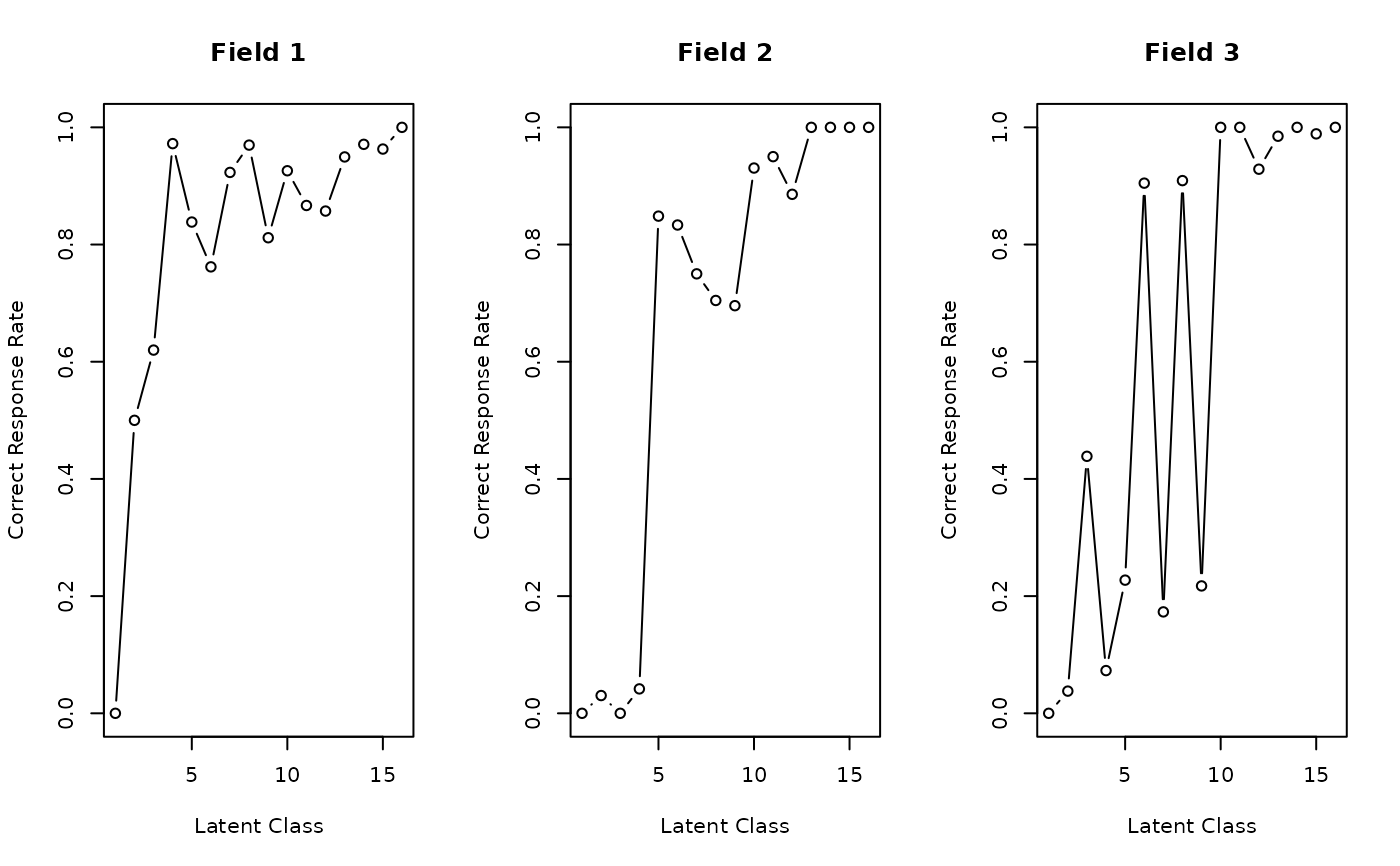
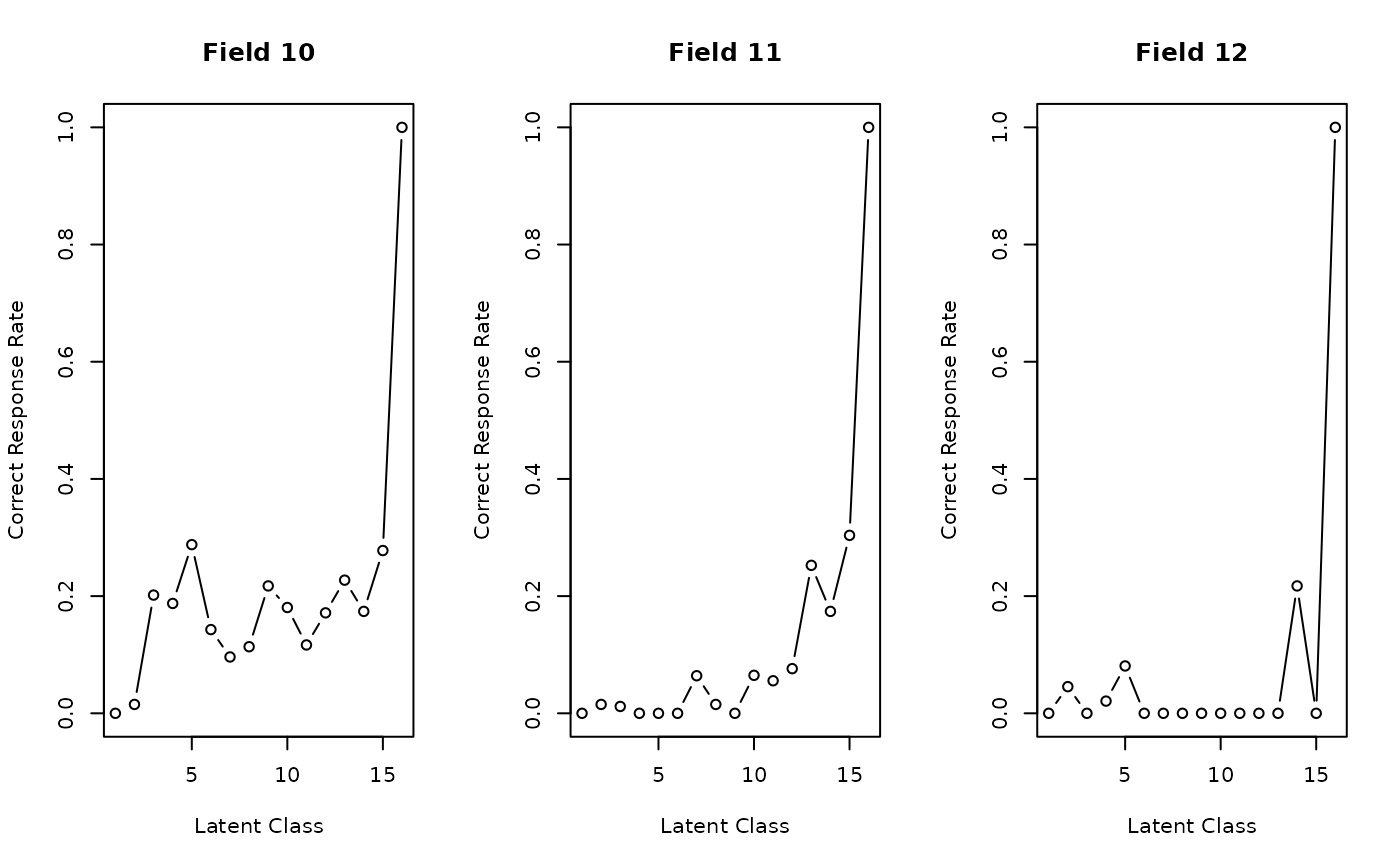
plot(result, type = "FRP", nc = 3)
# Plot Field Reference Profiles (FRP) in a 3-column grid
plot(result, type = "FRP", nc = 3)
 # }
# \donttest{
result <- Biclustering_IRM(J15S500, gamma_c = 1, gamma_f = 1)
plot(result, type = "Array")
# }
# \donttest{
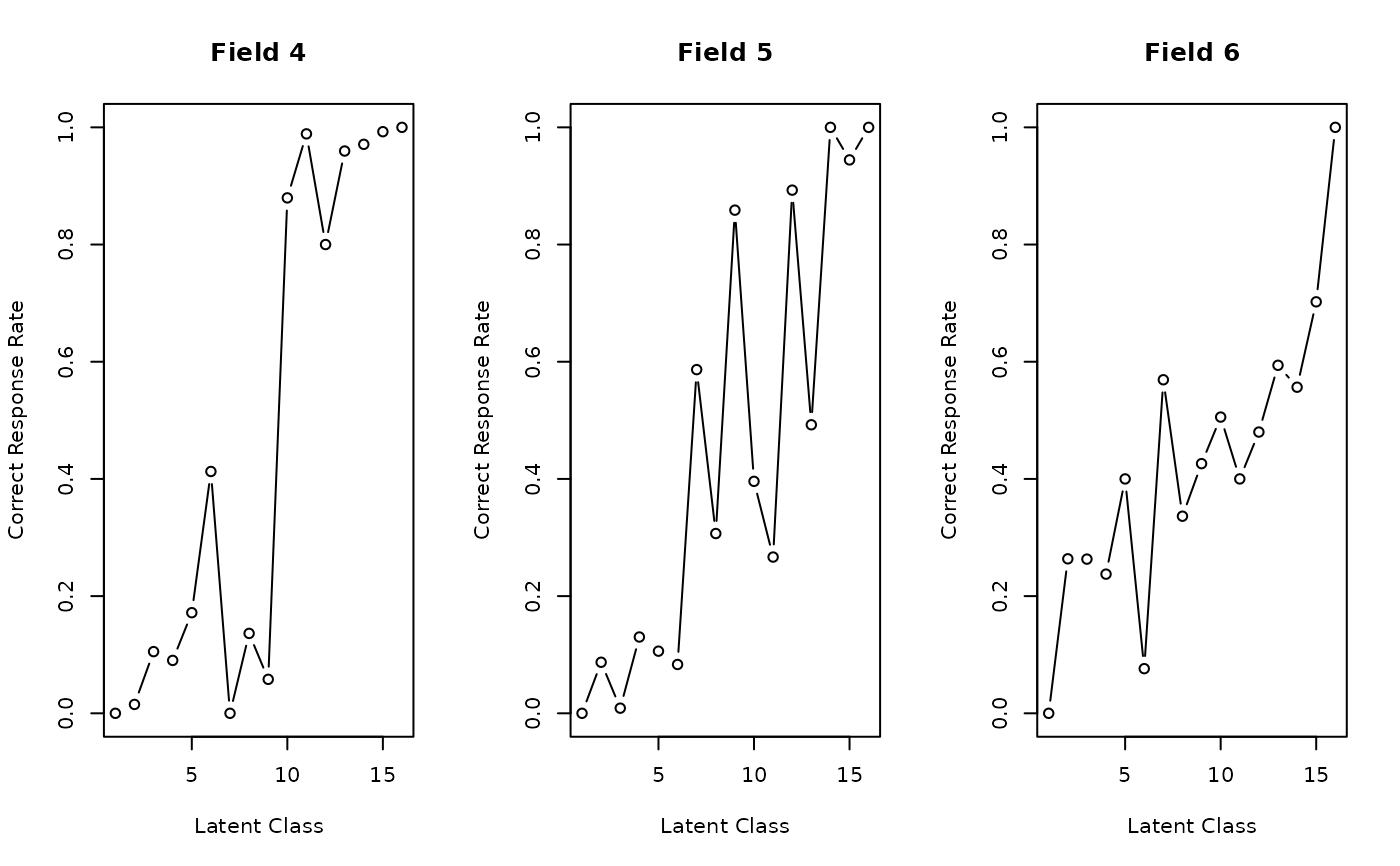
result <- Biclustering_IRM(J15S500, gamma_c = 1, gamma_f = 1)
plot(result, type = "Array")
 # }
# \donttest{
# Fit a nominal Biclustering IRM model
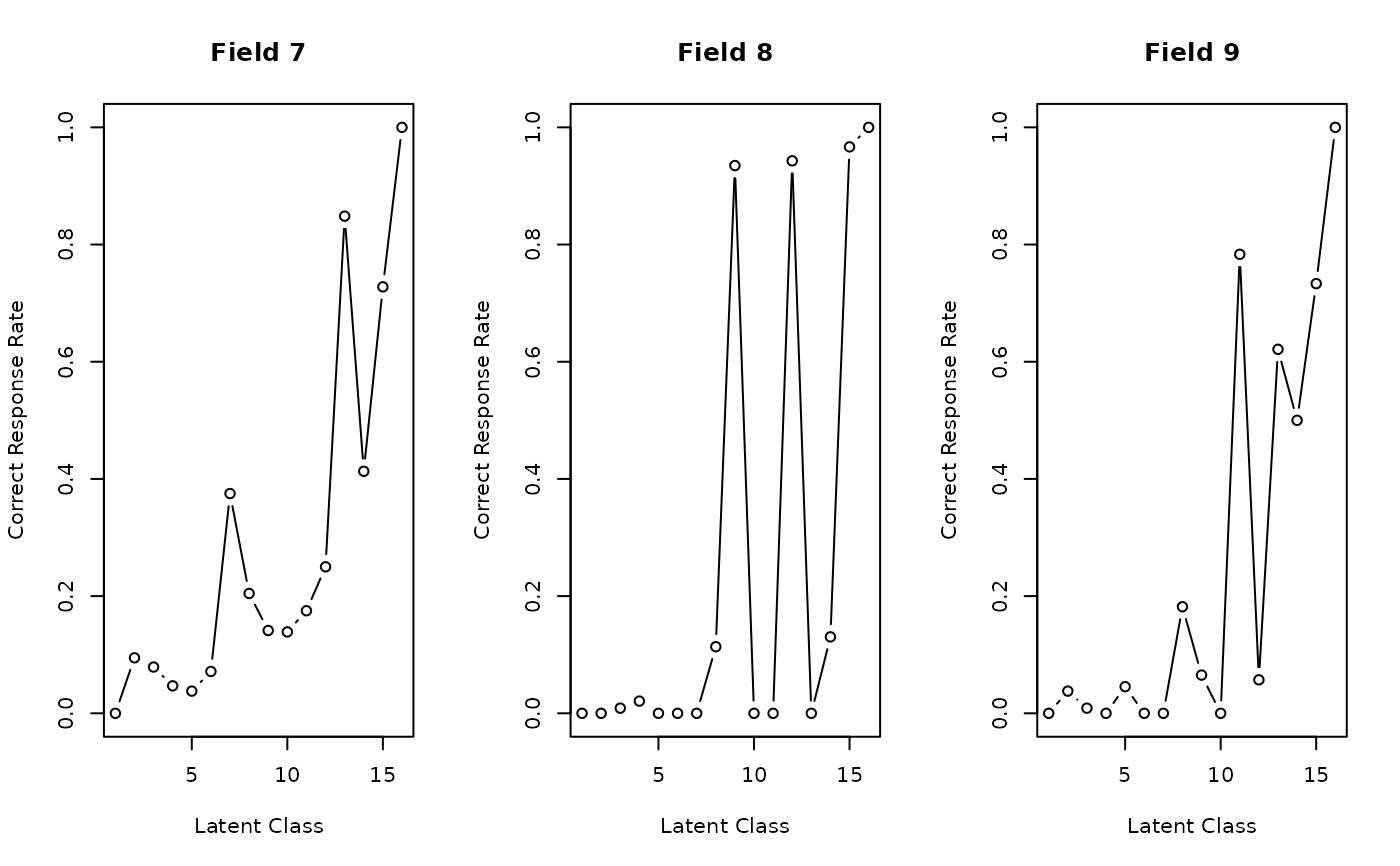
result <- Biclustering_IRM(J20S600, gamma_c = 1, gamma_f = 1, verbose = TRUE)
#> iter 1: match=0 nfld=7 ncls=5
#> iter 2: match=0 nfld=4 ncls=9
#> iter 3: match=1 nfld=4 ncls=7
#> iter 4: match=2 nfld=4 ncls=7
#> iter 5: match=3 nfld=4 ncls=7
#> iter 6: match=4 nfld=4 ncls=7
#> iter 7: match=5 nfld=4 ncls=6
#> Adjusting classes: BIC=28653.8 ncls=6 (min size < 20)
plot(result, type = "Array")
# }
# \donttest{
# Fit a nominal Biclustering IRM model
result <- Biclustering_IRM(J20S600, gamma_c = 1, gamma_f = 1, verbose = TRUE)
#> iter 1: match=0 nfld=7 ncls=5
#> iter 2: match=0 nfld=4 ncls=9
#> iter 3: match=1 nfld=4 ncls=7
#> iter 4: match=2 nfld=4 ncls=7
#> iter 5: match=3 nfld=4 ncls=7
#> iter 6: match=4 nfld=4 ncls=7
#> iter 7: match=5 nfld=4 ncls=6
#> Adjusting classes: BIC=28653.8 ncls=6 (min size < 20)
plot(result, type = "Array")
 # }
# \donttest{
# Fit an ordinal Biclustering IRM model
result <- Biclustering_IRM(J35S500, gamma_c = 1, gamma_f = 1, verbose = TRUE)
#> iter 1: match=0 nfld=7 ncls=47
#> iter 2: match=0 nfld=6 ncls=23
#> iter 3: match=1 nfld=6 ncls=16
#> iter 4: match=2 nfld=6 ncls=12
#> iter 5: match=3 nfld=6 ncls=8
#> iter 6: match=4 nfld=6 ncls=8
#> iter 7: match=5 nfld=6 ncls=8
#> Adjusting classes: BIC=40873.5 ncls=8 (min size < 20)
plot(result, type = "Array")
# }
# \donttest{
# Fit an ordinal Biclustering IRM model
result <- Biclustering_IRM(J35S500, gamma_c = 1, gamma_f = 1, verbose = TRUE)
#> iter 1: match=0 nfld=7 ncls=47
#> iter 2: match=0 nfld=6 ncls=23
#> iter 3: match=1 nfld=6 ncls=16
#> iter 4: match=2 nfld=6 ncls=12
#> iter 5: match=3 nfld=6 ncls=8
#> iter 6: match=4 nfld=6 ncls=8
#> iter 7: match=5 nfld=6 ncls=8
#> Adjusting classes: BIC=40873.5 ncls=8 (min size < 20)
plot(result, type = "Array")
 # }
# \donttest{
# Fit a rated Biclustering IRM model
result <- Biclustering_IRM(J21S300, gamma_c = 1, gamma_f = 1, verbose = TRUE)
#> iter 1: match=0 nfld=11 ncls=7
#> iter 2: match=0 nfld=6 ncls=9
#> iter 3: match=0 nfld=5 ncls=7
#> iter 4: match=0 nfld=3 ncls=6
#> iter 5: match=1 nfld=3 ncls=5
#> iter 6: match=2 nfld=3 ncls=6
#> iter 7: match=3 nfld=3 ncls=5
#> iter 8: match=4 nfld=3 ncls=4
#> iter 9: match=5 nfld=3 ncls=4
#>
#> Weakly ordinal alignment condition was satisfied.
plot(result, type = "Array")
# }
# \donttest{
# Fit a rated Biclustering IRM model
result <- Biclustering_IRM(J21S300, gamma_c = 1, gamma_f = 1, verbose = TRUE)
#> iter 1: match=0 nfld=11 ncls=7
#> iter 2: match=0 nfld=6 ncls=9
#> iter 3: match=0 nfld=5 ncls=7
#> iter 4: match=0 nfld=3 ncls=6
#> iter 5: match=1 nfld=3 ncls=5
#> iter 6: match=2 nfld=3 ncls=6
#> iter 7: match=3 nfld=3 ncls=5
#> iter 8: match=4 nfld=3 ncls=4
#> iter 9: match=5 nfld=3 ncls=4
#>
#> Weakly ordinal alignment condition was satisfied.
plot(result, type = "Array")
 # }
# }