
A general function for estimating Latent Rank Analysis across different response types. This function automatically dispatches to the appropriate method based on the response type:
For binary data (
LRA.binary): Analysis using either SOM or GTM methodFor ordinal data (
LRA.ordinal): Analysis using the GTM method with category thresholdsFor rated data (
LRA.rated): Analysis using the GTM method with rating categories
Latent Rank Analysis identifies underlying rank structures in test data and assigns examinees to these ranks based on their response patterns.
Usage
LRA(U, ...)

# Default S3 method
LRA(U, na = NULL, Z = NULL, w = NULL, ...)

# S3 method for class 'binary'
LRA(
  U,
  nrank = 2,
  method = "isotonic",
  mic = FALSE,
  maxiter = 1000,
  BIC.check = FALSE,
  seed = NULL,
  verbose = FALSE,
  beta1 = 1,
  beta2 = 1,
  conf = NULL,
  ...
)

# S3 method for class 'ordinal'
LRA(
  U,
  nrank = 2,
  method = "isotonic",
  mic = FALSE,
  maxiter = 1000,
  trapezoidal = 0,
  alpha = 1,
  eps = 1e-04,
  verbose = FALSE,
  ...
)

# S3 method for class 'rated'
LRA(
  U,
  nrank = 2,
  mic = FALSE,
  maxiter = 1000,
  trapezoidal = 0,
  eps = 1e-04,
  minFreqRatio = 0,
  verbose = FALSE,
  ...
)
Arguments
- U
Either an object of class "exametrika" or raw data. When raw data is given, it is converted to the exametrika class with the
dataFormatfunction.- ...
Additional arguments passed to specific methods.
- na
Values to be treated as missing values.
- Z
Missing indicator matrix of type matrix or data.frame. 1 indicates observed values, 0 indicates missing values.
- w
Item weight vector.
- nrank
Number of latent ranks to estimate. Must be between 2 and 20.
- method
Estimation method. One of "isotonic" (order-restricted MAP; rank ordering imposed in the M-step by the Fenchel-dual stochastic-order solver, no filter) or "GTM" (Gaussian Topographic Mapping; filter smoothing). Default is "isotonic".
- mic
Logical; if TRUE, forces Item Reference Profiles to be monotonically increasing. Default is FALSE.
- maxiter
Maximum number of iterations for estimation. Default is 1000. For the SOM method this also sets the length of the annealing schedule, so changing it changes the solution rather than merely allowing more iterations.
- BIC.check
For binary data with SOM method only. If TRUE, estimation stops early once the change in BIC falls below a threshold. This is an early-stopping option, not a convergence test: SOM has no convergence criterion. Default is FALSE.
- seed
For binary data with SOM method only. Random seed for reproducibility. It affects only which presentation orders are drawn, not the algorithm itself.
- verbose
Logical; if TRUE, displays detailed progress during estimation. Default is FALSE.
- beta1
Beta distribution parameter 1 for prior density of rank reference matrix (GTM method only). Default is 1.
- beta2
Beta distribution parameter 2 for prior density of rank reference matrix (GTM method only). Default is 1.
- conf
Confirmatory IRP matrix (items x nrank) for test equating. Same format as the IRP output. Non-NA values are fixed throughout estimation, NA values are freely estimated. Fixed values must be in the open interval (0, 1). When row names are present, items are matched by label; otherwise by position. Default is NULL (fully exploratory).
- trapezoidal
Specifies the height of both tails when using a trapezoidal prior distribution. Must be less than 1/nrank. The default value is 0, which results in a uniform prior distribution. Used by
method = "GTM".- alpha
Dirichlet concentration for the category probabilities, used by
method = "isotonic"(the polytomous analogue of the binarybeta1/beta2).alpha = 1gives the maximum-likelihood (flat-prior) estimate. Default is 1.- eps
Convergence threshold for parameter updates. Default is 1e-4.
- minFreqRatio
Minimum frequency ratio for response categories (default = 0). Categories with occurrence rates below this threshold will be excluded from analysis. For example, if set to 0.1, response categories that appear in less than 10% of responses for an item will be omitted.
Value
A list of class "exametrika" and the specific subclass (e.g., "LRA", "LRAordinal", "LRArated") containing the following common elements:
- msg
A character string indicating the model type.
- testlength
Length of the test (number of items).
- nobs
Sample size (number of rows in the dataset).
- n_rank
Number of latent ranks specified.
- n_cycle
Number of EM algorithm iterations performed.
- converge
Logical value indicating whether the algorithm converged within maxiter iterations. The SOM method has no convergence criterion and runs its annealing schedule to completion, so this is TRUE unless BIC.check early stopping failed to trigger.
- TRP
Test Reference Profile vector showing expected scores at each rank.
- LRD
Latent Rank Distribution vector showing the number of examinees at each rank.
- RMD
Rank Membership Distribution vector showing the sum of probabilities for each rank.
- Students
Rank Membership Profile matrix showing the posterior probabilities of examinees belonging to each rank, along with their estimated ranks and odds ratios.
- ItemFitIndices
Fit indices for each item. See also
ItemFit.- TestFitIndices
Overall fit indices for the test. See also
TestFit.- elbo
Evidence lower bound of the observed-data log-likelihood under the posterior memberships the EM produced. Exact (equal to the observed-data log-likelihood) for a one-mode model; a lower bound for biclustering, where the respondent and item posteriors are taken independent. Since 2.2.0.
- log_lik_marginal
Observed-data log-likelihood of the respondent-side mixture with the items fixed at their MAP field assignment. Equal to
elbofor a one-mode model.- entropy
Posterior entropy of the memberships (named:
class, andfieldfor biclustering).elbominus this is the expected complete-data log-likelihood.- ICL
Integrated completed likelihood criterion (Biernacki, Celeux and Govaert, 2000) in its BIC-type approximation, on the same scale as AIC and BIC (-2 log scale, smaller is better).
Each subclass returns additional specific elements, detailed in their respective documentation.
For binary data (LRA.binary), the returned list additionally includes:
- IRP
Item Reference Profile matrix showing the probability of correct response for each item across different ranks.
- IRPIndex
Item Response Profile indices including the location parameters B and Beta, slope parameters A and Alpha, and monotonicity indices C and Gamma.
For ordinal data (LRA.ordinal), the returned list additionally includes:
- msg
A character string indicating the model type.
- converge
Logical value indicating whether the algorithm converged within maxiter iterations
- ScoreReport
Descriptive statistics of test performance, including sample size, test length, central tendency, variability, distribution characteristics, and reliability.
- ItemReport
Basic statistics for each item including category proportions and item-total correlations.
- ICBR
Item Category Boundary Reference matrix showing cumulative probabilities for rank-category combinations.
- ICRP
Item Category Reference Profile matrix showing probability of response in each category by rank.
- CategoryMap, LogPrior
The raw codes behind the rows of
ICRPfor each item, and the log prior over ranks; used bypredict.exametrika().- ScoreRankCorr
Spearman's correlation between test scores and estimated ranks.
- RankQuantCorr
Spearman's correlation between estimated ranks and quantile groups.
- ScoreRank
Contingency table of raw scores by estimated ranks.
- ScoreMembership
Expected rank memberships for each raw score.
- RankQuantile
Cross-tabulation of rank frequencies and quantile groups.
- MembQuantile
Cross-tabulation of rank membership probabilities and quantile groups.
- CatQuant
Response patterns across item categories and quantile groups.
- log_lik
Expected log-posterior at the final EM cycle, the quantity the EM monitors; the observed-data log-likelihood is
elbo.- elbo
Evidence lower bound of the observed-data log-likelihood under the posterior memberships the EM produced. Exact (equal to the observed-data log-likelihood) for a one-mode model; a lower bound for biclustering, where the respondent and item posteriors are taken independent. Since 2.2.0.
- log_lik_marginal
Observed-data log-likelihood of the respondent-side mixture with the items fixed at their MAP field assignment. Equal to
elbofor a one-mode model.- entropy
Posterior entropy of the memberships (named:
class, andfieldfor biclustering).elbominus this is the expected complete-data log-likelihood.- ICL
Integrated completed likelihood criterion (Biernacki, Celeux and Govaert, 2000) in its BIC-type approximation, on the same scale as AIC and BIC (-2 log scale, smaller is better).
For rated data (LRA.rated), the returned list additionally includes:
- msg
A character string indicating the model type.
- converge
Logical value indicating whether the algorithm converged within maxiter iterations
- ScoreReport
Descriptive statistics of test performance, including sample size, test length, central tendency, variability, distribution characteristics, and reliability.
- ItemReport
Basic statistics for each item including category proportions and item-total correlations.
- ICRP
Item Category Reference Profile matrix showing probability of response in each category by rank.
- CategoryMap, CollapseCode, LogPrior
The raw codes behind the rows of
ICRPfor each item (CollapseCodemarks the pooled rare distractors), and the log prior over ranks; used bypredict.exametrika().- ScoreRankCorr
Spearman's correlation between test scores and estimated ranks.
- RankQuantCorr
Spearman's correlation between estimated ranks and quantile groups.
- ScoreRank
Contingency table of raw scores by estimated ranks.
- ScoreMembership
Expected rank memberships for each raw score.
- RankQuantile
Cross-tabulation of rank frequencies and quantile groups.
- MembQuantile
Cross-tabulation of rank membership probabilities and quantile groups.
- ItemQuantileRef
Reference values for each item across quantile groups.
- CatQuant
Response patterns across item categories and quantile groups.
- log_lik
Expected log-posterior at the final EM cycle, the quantity the EM monitors; the observed-data log-likelihood is
elbo.- elbo
Evidence lower bound of the observed-data log-likelihood under the posterior memberships the EM produced. Exact (equal to the observed-data log-likelihood) for a one-mode model; a lower bound for biclustering, where the respondent and item posteriors are taken independent. Since 2.2.0.
- log_lik_marginal
Observed-data log-likelihood of the respondent-side mixture with the items fixed at their MAP field assignment. Equal to
elbofor a one-mode model.- entropy
Posterior entropy of the memberships (named:
class, andfieldfor biclustering).elbominus this is the expected complete-data log-likelihood.- ICL
Integrated completed likelihood criterion (Biernacki, Celeux and Govaert, 2000) in its BIC-type approximation, on the same scale as AIC and BIC (-2 log scale, smaller is better).
Binary Data Method
LRA.binary analyzes dichotomous (0/1) response data using either Self-Organizing Maps (SOM)
or Gaussian Topographic Mapping (GTM).
Ordinal Data Method
LRA.ordinal analyzes ordered categorical data with multiple thresholds,
such as Likert-scale responses or graded items.
Rated Data Method
LRA.rated analyzes data with ratings assigned to each response, such as
partially-credited items or preference scales where response categories have different weights.
See also
plot.exametrika for visualizing LRA results.
Examples
# \donttest{
# Binary data example
# Fit a Latent Rank Analysis model with 6 ranks to binary data
result.LRA <- LRA(J15S500, nrank = 6)
# Display the first few rows of student rank membership profiles
head(result.LRA$Students)
#> Membership 1 Membership 2 Membership 3 Membership 4 Membership 5
#> Student001 0.373362828 0.428218832 0.11222243 0.03023517 0.055960736
#> Student002 0.020038540 0.080823095 0.57927688 0.28286515 0.036996142
#> Student003 0.006211982 0.213060043 0.54320920 0.14635238 0.076437420
#> Student004 0.001004123 0.009115719 0.19879539 0.29307173 0.133726701
#> Student005 0.252721804 0.727486696 0.01394724 0.00375769 0.001962579
#> Student006 0.000130071 0.002051624 0.04590205 0.06767055 0.766752034
#> Membership 6 Estimate Rank-Up Odds Rank-Down Odds
#> Student001 6.586004e-09 2 0.26206795 0.87189726
#> Student002 1.929370e-07 3 0.48830733 0.13952412
#> Student003 1.472897e-02 3 0.26942176 0.39222466
#> Student004 3.642863e-01 6 NA 0.36709228
#> Student005 1.239901e-04 2 0.01917182 0.34739028
#> Student006 1.174937e-01 5 0.15323555 0.08825611
# Plot Item Reference Profiles (IRP) for the first 6 items
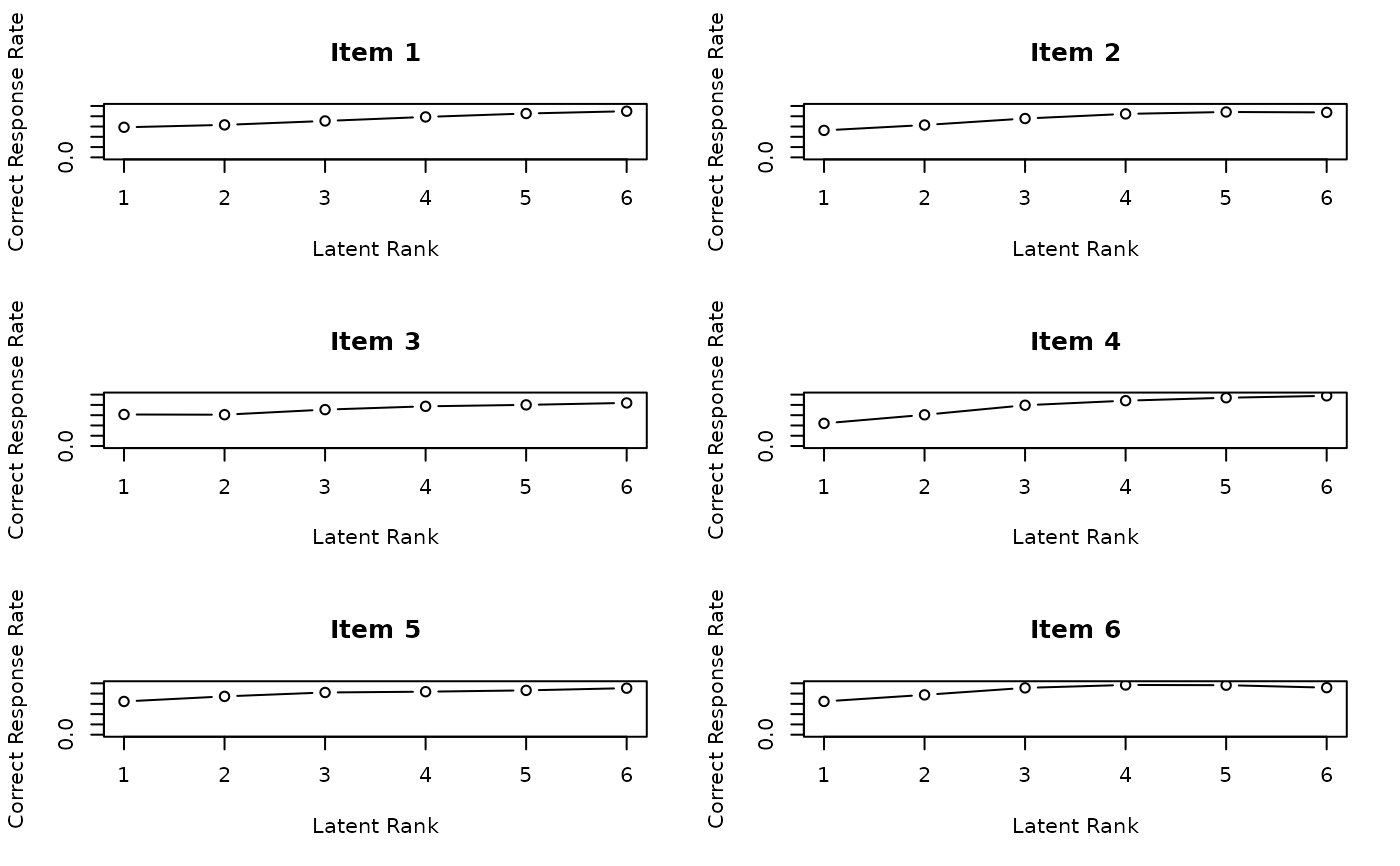
plot(result.LRA, type = "IRP", items = 1:6, nc = 2, nr = 3)
 # Plot Test Reference Profile (TRP) showing expected scores at each rank
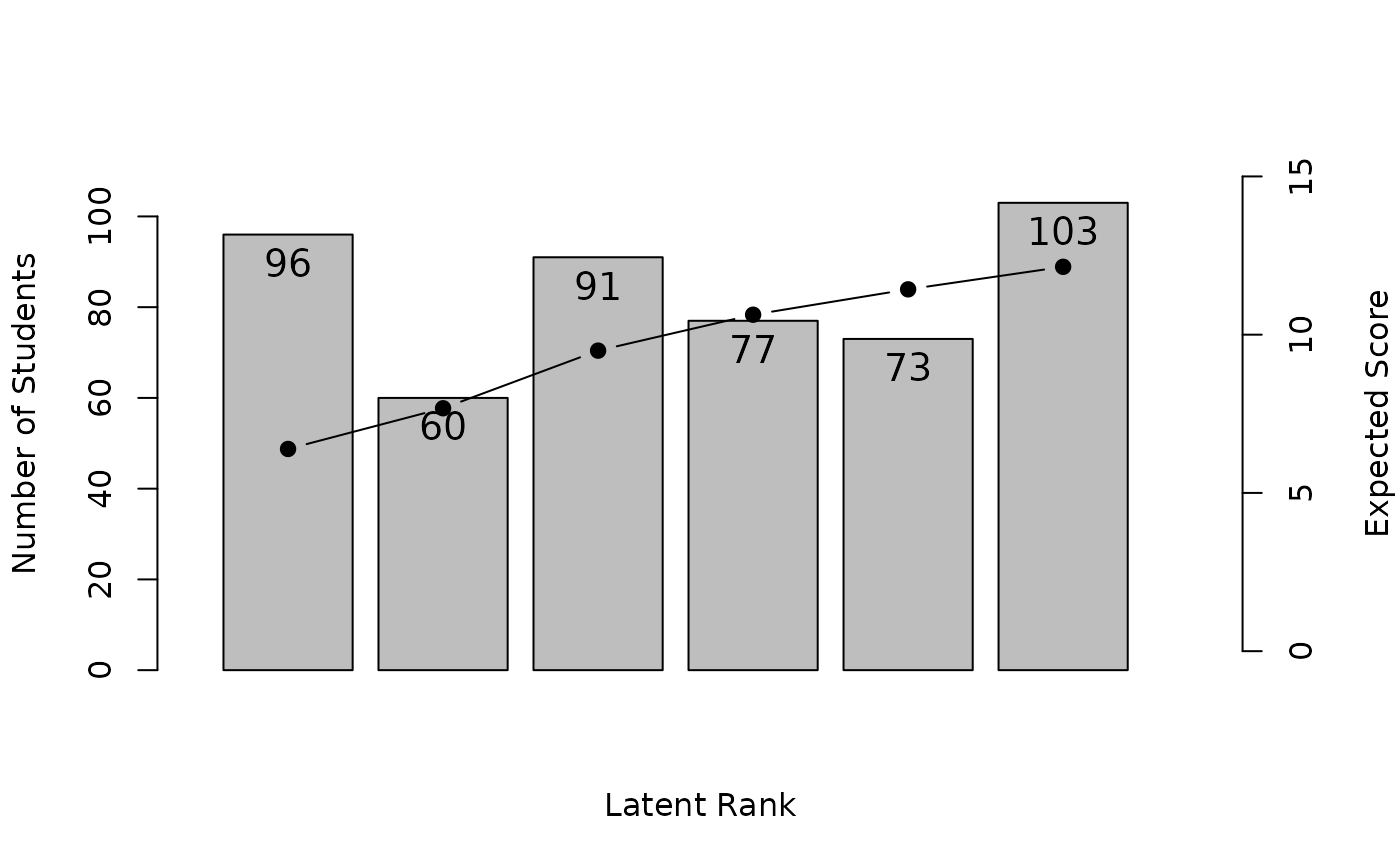
plot(result.LRA, type = "TRP")
# Plot Test Reference Profile (TRP) showing expected scores at each rank
plot(result.LRA, type = "TRP")
 # }
# \donttest{
# Ordinal data example
# Fit a Latent Rank Analysis model with 3 ranks to ordinal data
result.LRAord <- LRA(J15S3810, nrank = 3, mic = TRUE)
# Plot score distributions
plot(result.LRAord, type = "ScoreFreq")
# }
# \donttest{
# Ordinal data example
# Fit a Latent Rank Analysis model with 3 ranks to ordinal data
result.LRAord <- LRA(J15S3810, nrank = 3, mic = TRUE)
# Plot score distributions
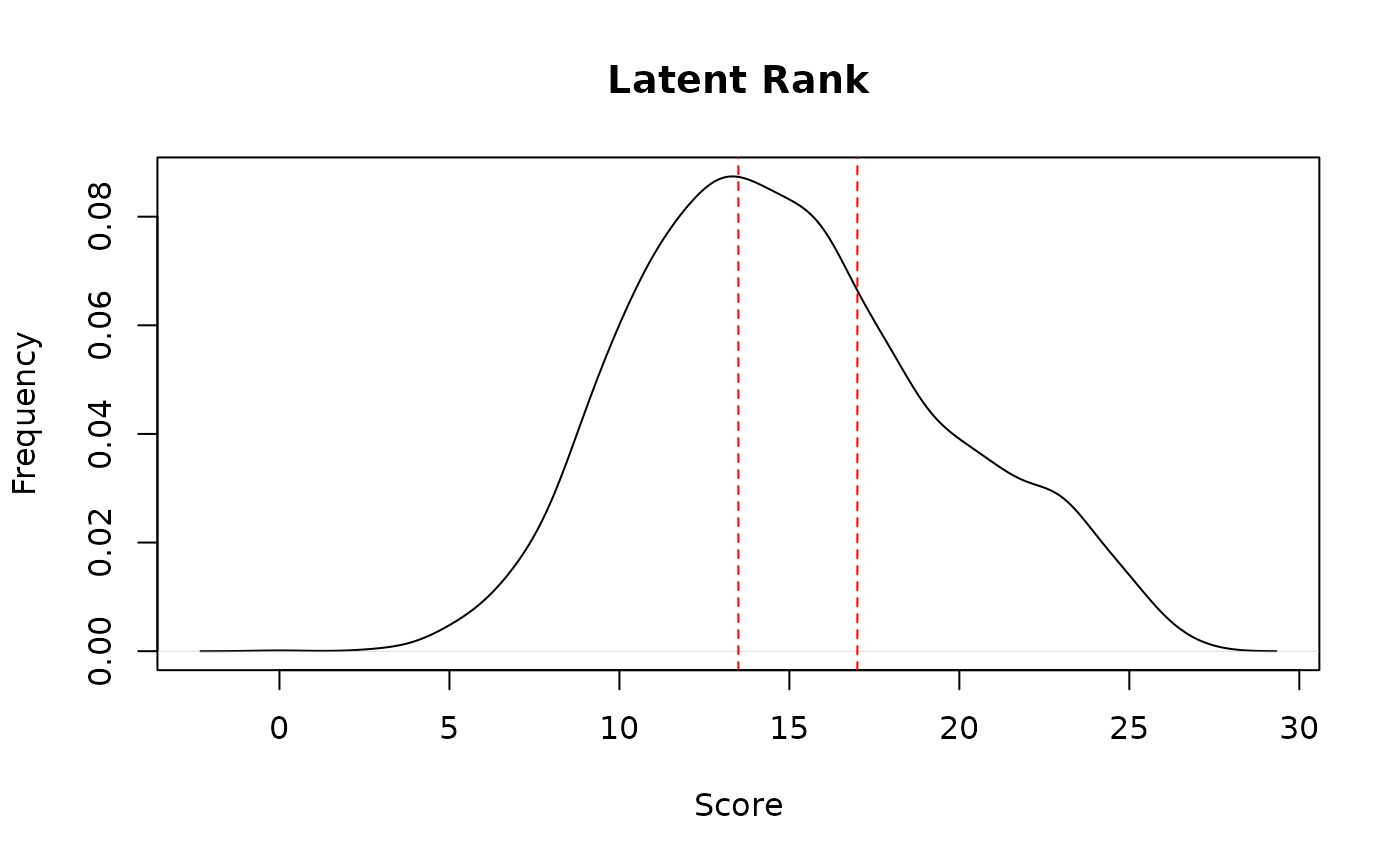
plot(result.LRAord, type = "ScoreFreq")
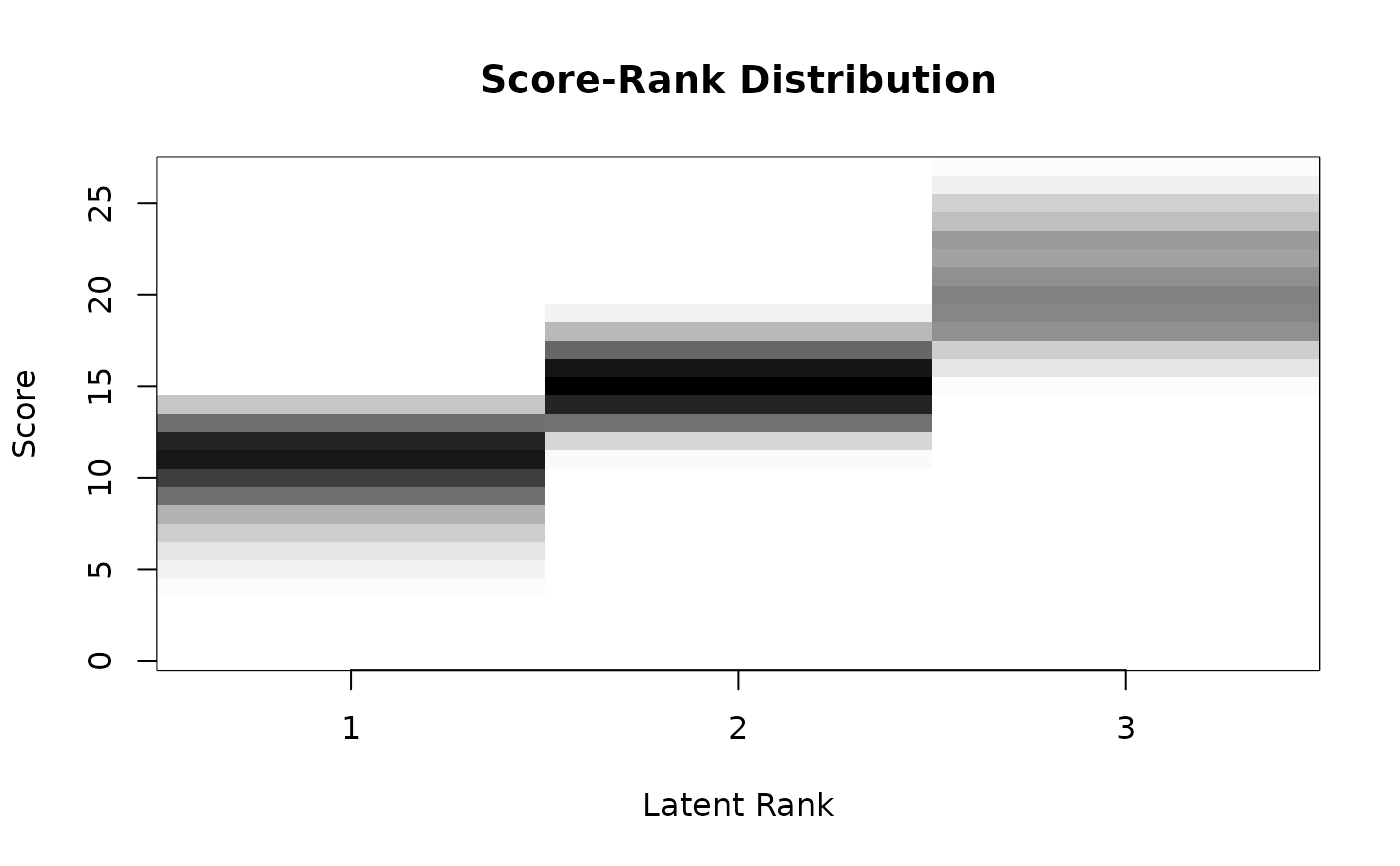
 plot(result.LRAord, type = "ScoreRank")
 # Plot category response patterns for items 1-6
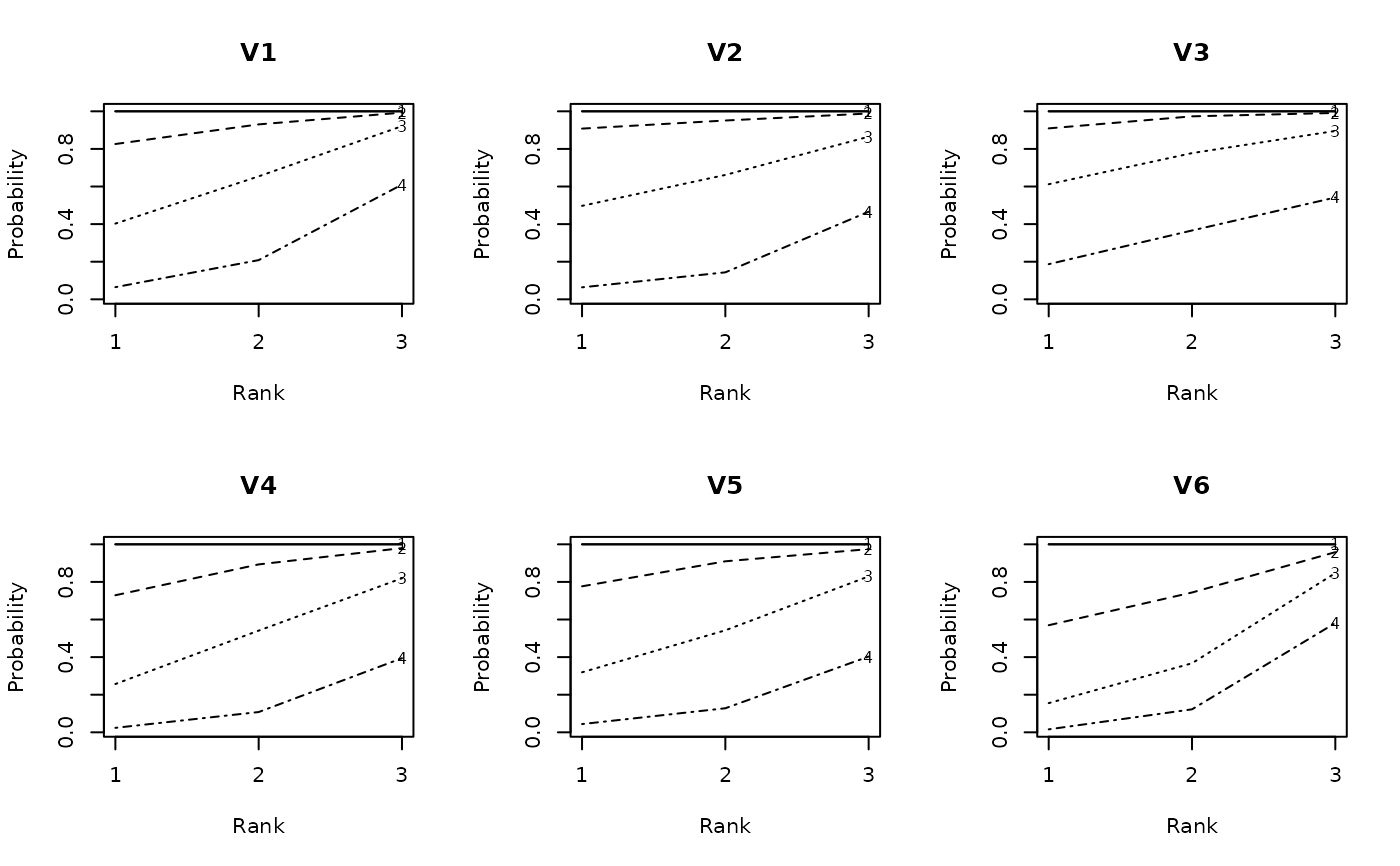
plot(result.LRAord, type = "ICBR", items = 1:6, nc = 3, nr = 2)
# Plot category response patterns for items 1-6
plot(result.LRAord, type = "ICBR", items = 1:6, nc = 3, nr = 2)
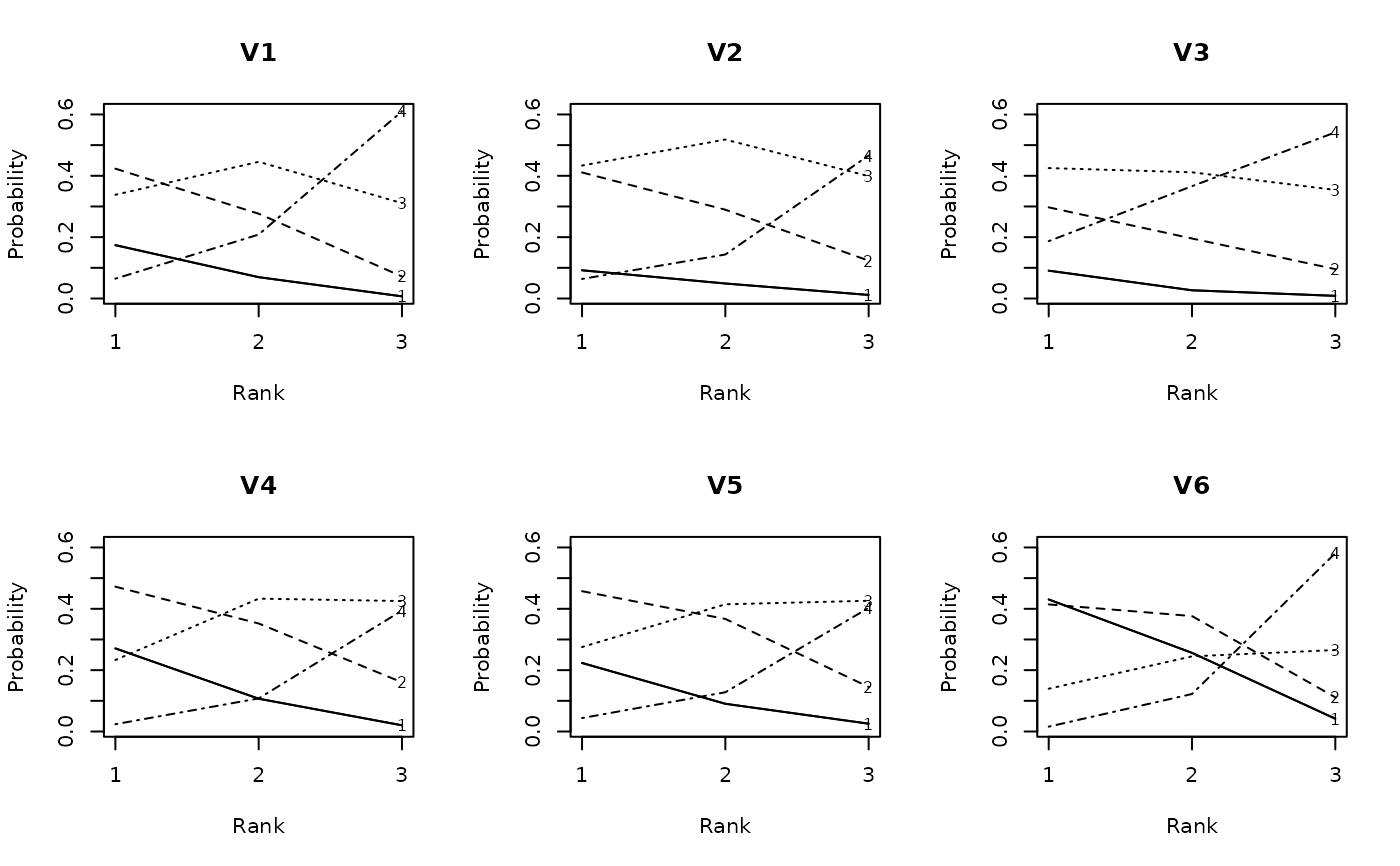
 plot(result.LRAord, type = "ICRP", items = 1:6, nc = 3, nr = 2)
 # }
# \donttest{
# Rated data example
# Fit a Latent Rank Analysis model with 10 ranks to rated data
result.LRArated <- LRA(J35S5000, nrank = 10, mic = TRUE)
#> Warning: LRA: the following categories had no responses and were dropped; the categories above them were renumbered for that item.
#> V30: category 5
# Plot score distributions
plot(result.LRArated, type = "ScoreFreq")
# }
# \donttest{
# Rated data example
# Fit a Latent Rank Analysis model with 10 ranks to rated data
result.LRArated <- LRA(J35S5000, nrank = 10, mic = TRUE)
#> Warning: LRA: the following categories had no responses and were dropped; the categories above them were renumbered for that item.
#> V30: category 5
# Plot score distributions
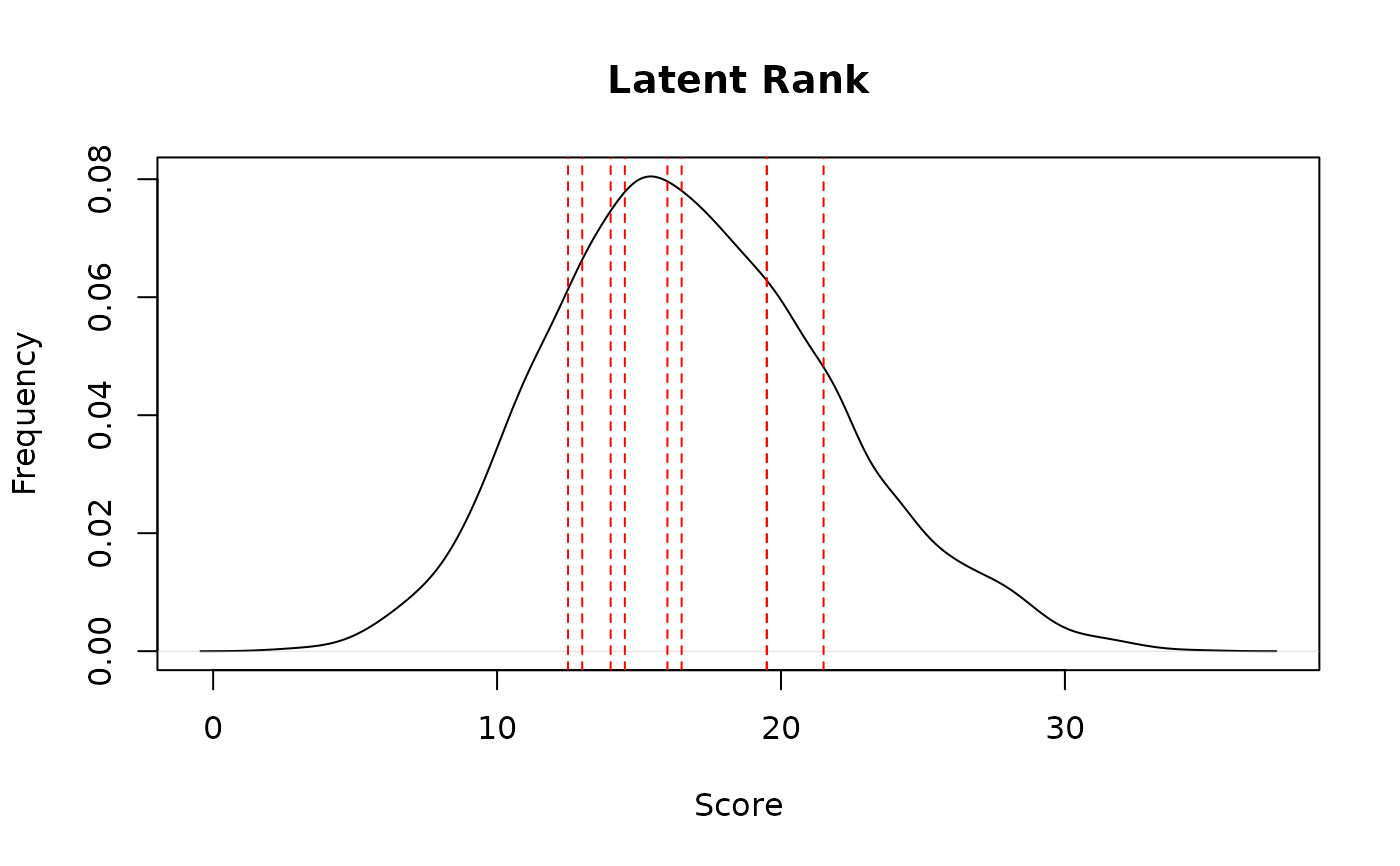
plot(result.LRArated, type = "ScoreFreq")
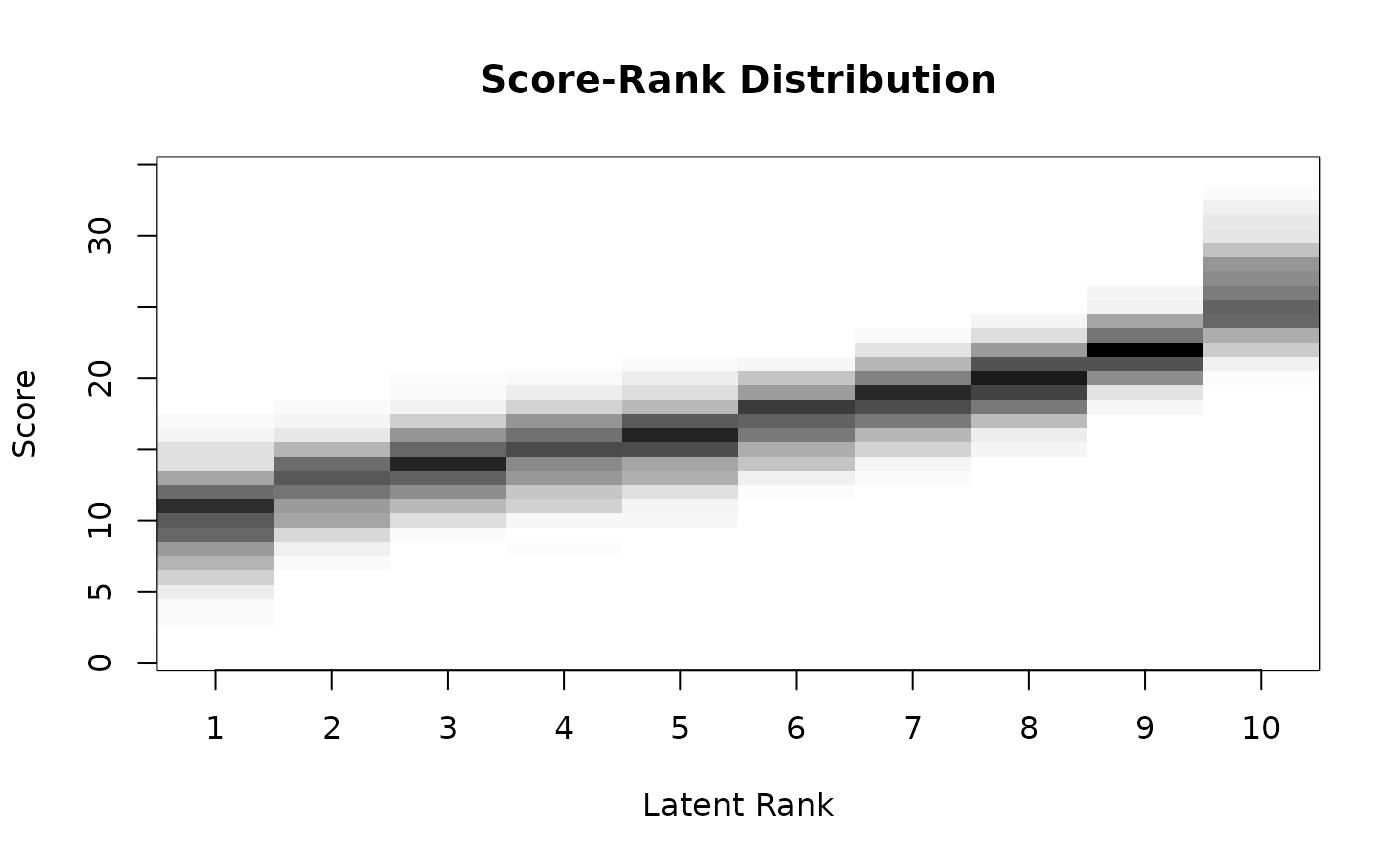
 plot(result.LRArated, type = "ScoreRank")
 # Plot category response patterns for items 1-6
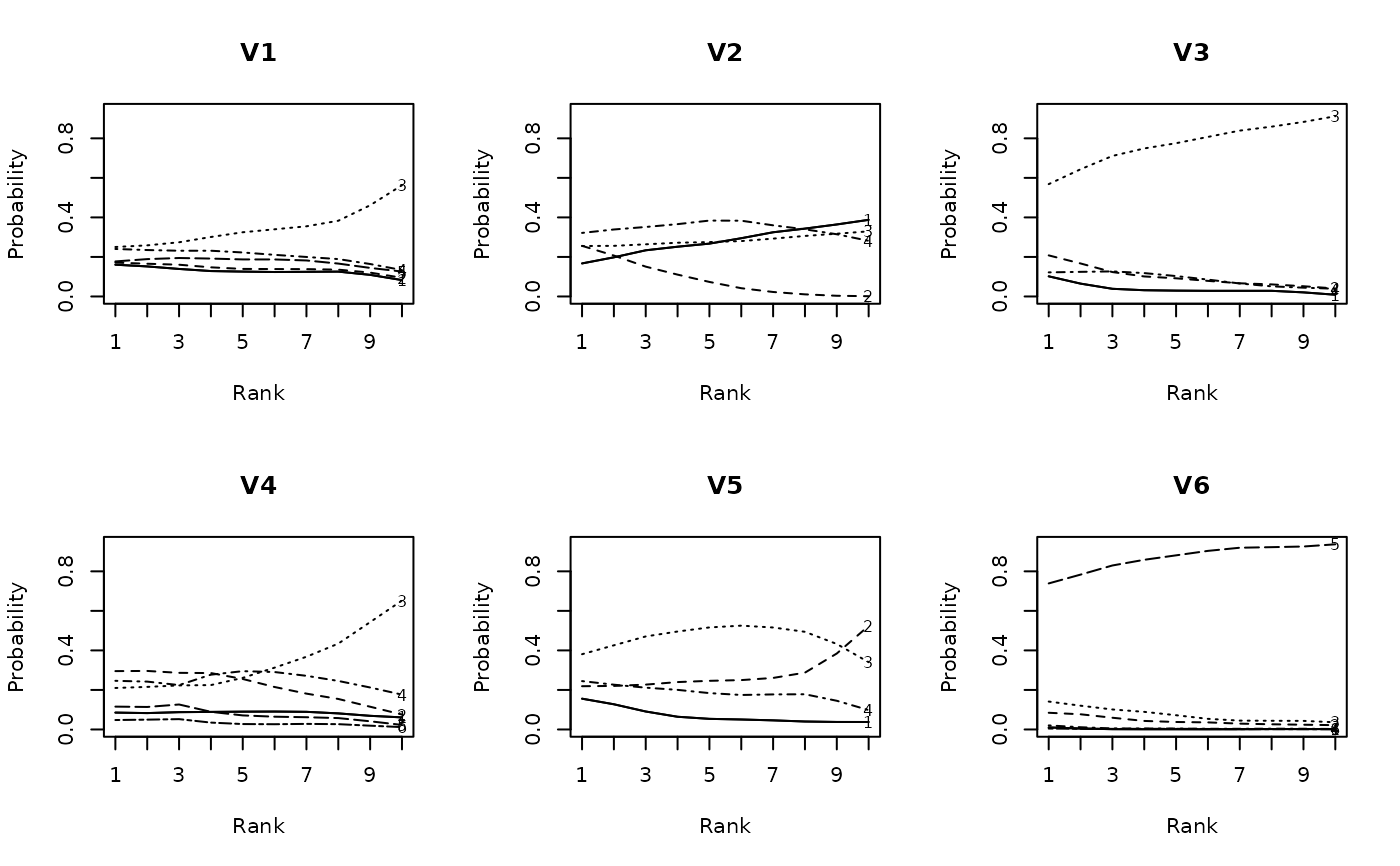
plot(result.LRArated, type = "ICRP", items = 1:6, nc = 3, nr = 2)
# Plot category response patterns for items 1-6
plot(result.LRArated, type = "ICRP", items = 1:6, nc = 3, nr = 2)
 # }
# }