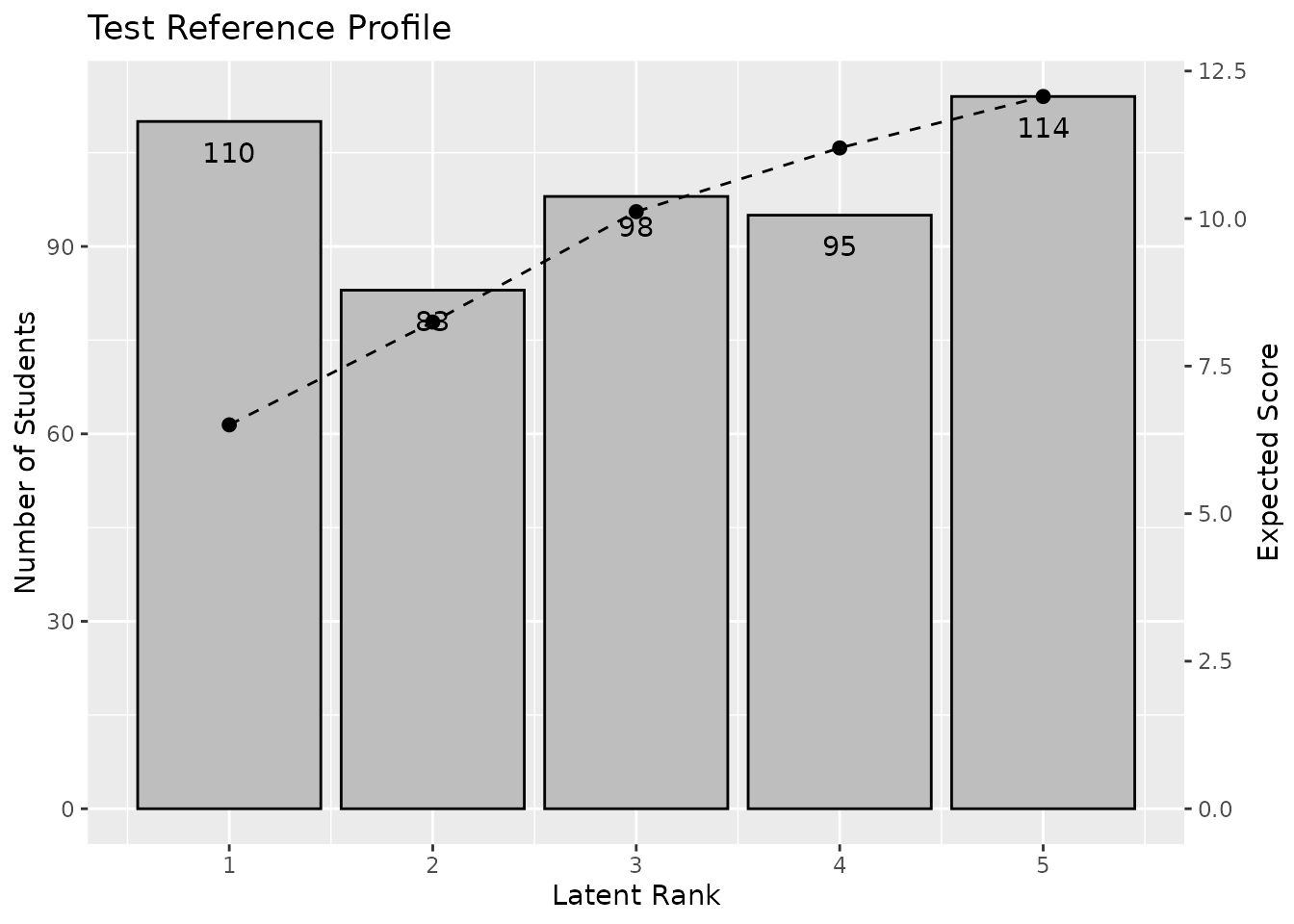
This function takes exametrika output as input and generates a Test Reference Profile (TRP) plot using ggplot2. TRP shows the number of students in each latent class/rank (bar graph) and the expected test score for each class/rank (line graph).
Usage
plotTRP_gg(
  data,
  Num_Students = TRUE,
  title = TRUE,
  colors = NULL,
  linetype = "dashed",
  show_legend = FALSE,
  legend_position = "right"
)
Arguments
- data
An object from exametrika: LCA, LRA, Biclustering, nominalBiclustering, ordinalBiclustering, ratedBiclustering, IRM, LDLRA, LDB, or BINET output.
- Num_Students
Logical. If
TRUE(default), display the number of students on each bar.- title
Logical or character. If
TRUE(default), display the auto-generated title. IfFALSE, no title. If a character string, use it as a custom title.- colors
Character vector of length 2. First element is the bar fill color, second is the line/point color. If
NULL(default), uses gray for bars and black for line/points.- linetype
Character or numeric specifying the line type for the expected score line. Default is
"dashed".- show_legend
Logical. If
TRUE, display the legend. Default isFALSE.- legend_position
Character. Position of the legend. One of
"right"(default),"top","bottom","left","none".
Value
A single ggplot object with dual y-axes showing both the student distribution and expected scores.
Details
The Test Reference Profile provides an overview of the latent structure. The bar graph shows how students are distributed across classes/ranks, while the line graph shows the expected test score for each class/rank. In well-fitted models, expected scores should increase monotonically with class/rank number.
Examples
library(exametrika)
result <- LRA(J15S500, nrank = 5)
plot <- plotTRP_gg(result)
plot